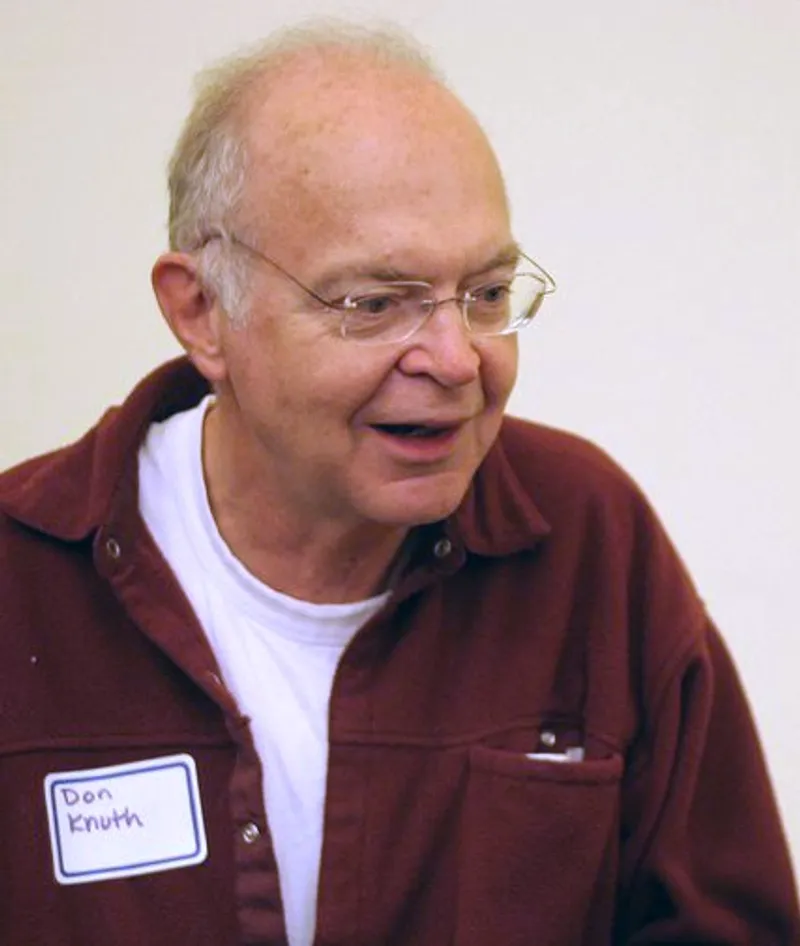
Donald Ervin Knuth (born 1938) is an American computer scientist and mathematician who established the rigorous mathematical study of algorithms. His multi-volume masterwork “The Art of Computer Programming” and his typesetting system TeX have profoundly influenced computer science and scientific publishing.
Early Life and Education
Donald Knuth was born on January 10, 1938, in Milwaukee, Wisconsin. His father, Ervin, was a school teacher who helped develop Donald’s love of education, music, and mathematics[1].
Knuth earned his bachelor’s degree (1960) in physics from Case Institute of Technology, where he was also awarded a master’s degree in mathematics based on the quality of his undergraduate thesis. He earned his PhD in mathematics from the California Institute of Technology in 1963.
The Art of Computer Programming
In 1962, while a graduate student at Caltech, Knuth was approached by Addison-Wesley to write a book about compilers. He proposed instead a comprehensive treatment of programming methods. That same day, he outlined twelve chapter titles for what would become his life’s work.
The first three volumes appeared in 1968, 1969, and 1973:
- Volume 1: Fundamental Algorithms
- Volume 2: Seminumerical Algorithms
- Volume 3: Sorting and Searching
- Volume 4A-B: Combinatorial Algorithms (2011, 2022)
The series, often called the “Bible” of computer science, introduced rigorous mathematical analysis of algorithms and made Big-O notation standard practice. Bill Gates famously said anyone who could read the whole thing should send him a résumé[2].
Analysis of Algorithms
Knuth is called the “father of the analysis of algorithms.” He systematized techniques for analyzing computational complexity, showing how to predict algorithm performance mathematically rather than through trial and error. His course at Stanford, “Analysis of Algorithms,” trained generations of computer scientists in these methods.
TeX and Digital Typography
In 1976, Knuth received galley proofs for the second edition of Volume 2 of TAOCP. The phototypesetting looked terrible compared to the original. Rather than accept inferior typography, he decided to create his own typesetting system.
What he estimated would take six months consumed nearly a decade. The result was TeX, a typesetting system of unprecedented quality. Knuth also created METAFONT (for designing fonts) and Computer Modern (a family of typefaces).
TeX became the standard for mathematical and scientific publishing. Leslie Lamport later built LaTeX on top of TeX, adding document structure commands. Today, virtually all mathematical papers are written in LaTeX.
Knuth released TeX as free software, anticipating the open-source movement. He offers cash rewards for bugs; version numbers converge toward π (currently 3.141592653).
Literate Programming
Knuth introduced literate programming—the idea that programs should be written primarily for humans to read, with machine execution as a secondary concern. His WEB system allowed mixing code with documentation, producing both executable programs and readable books from the same source.
Stanford Career
Knuth joined Stanford University in 1968 and was named Professor of The Art of Computer Programming in 1990. In 1992, he retired from regular teaching to focus on completing TAOCP, though he continues writing and remains Professor Emeritus.
At Stanford, he supervised over 30 PhD students and created influential courses including “Concrete Mathematics” (later a textbook) and his legendary “Programming and Problem Solving Seminar.”
Recognition
Knuth’s contributions have earned numerous awards:
- ACM Turing Award (1974)
- National Medal of Science (1979)
- ACM Grace Murray Hopper Award (1971)
- Foreign Member of the Royal Society (2003)
He is known for his attention to correctness, sending small checks to anyone who finds errors in his books.
Sources
- MacTutor. “Donald Knuth.” Biography including early life and education.
- Wikipedia. “The Art of Computer Programming.” History and influence of TAOCP.