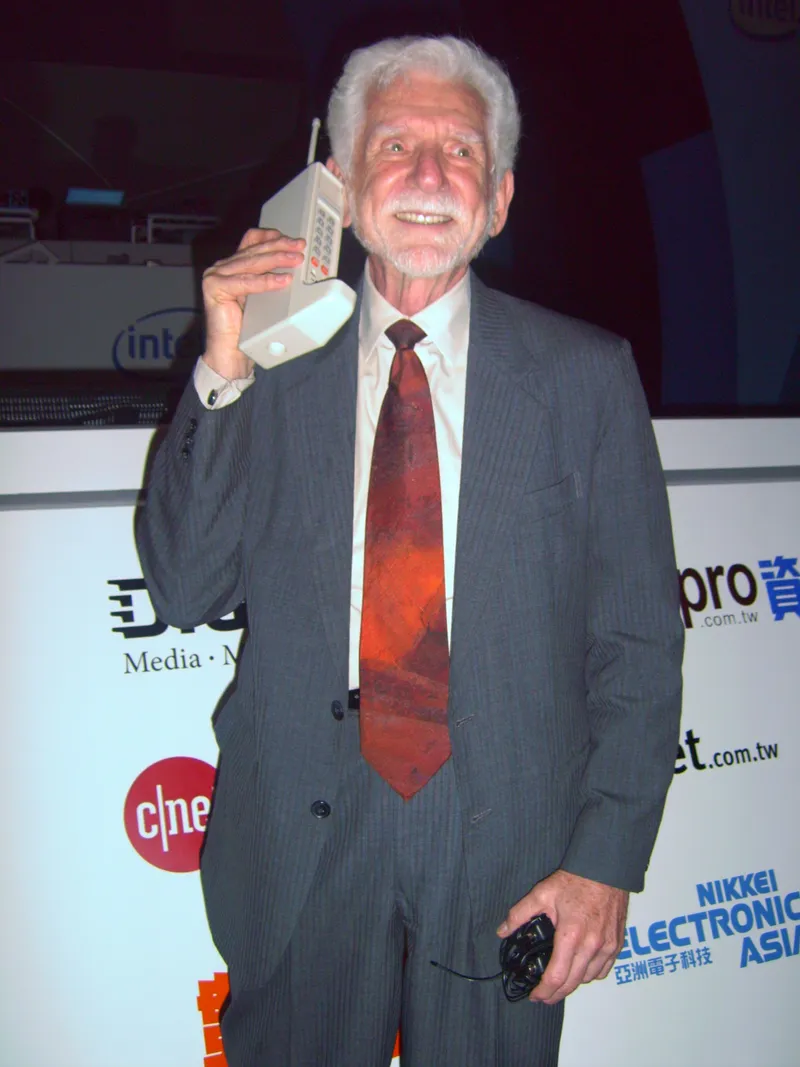
Martin Cooper (born 1928) is an American engineer who led the team that developed the first handheld cellular phone and made the first public cellular phone call on April 3, 1973. Often called the “father of the cell phone,” his vision of personal, portable communication transformed how billions of people live and work.
Early Life and Career
Cooper was born on December 26, 1928, in Chicago, Illinois. After serving in the U.S. Navy during the Korean War, he earned his bachelor’s degree in electrical engineering from the Illinois Institute of Technology in 1950 and his master’s degree in 1957[1].
After a brief stint at Teletype Corporation, Cooper joined Motorola in 1954 as a senior development engineer in the mobile equipment group. Over the following decades, he rose to lead the company’s communications systems division.
The Race for Cellular
In 1947, Bell Labs engineers had proposed cellular architecture—dividing large geographic areas into small cells, each with its own transmitter—to expand mobile phone capacity. However, AT&T envisioned car phones served by a monopoly network.
In 1968, the FCC asked AT&T to propose how to use UHF television spectrum for mobile communications. Motorola, seeing its mobile radio business threatened by an AT&T monopoly, decided to compete. Cooper was put in charge of an urgent project with a crucial difference: he believed mobile phones should be personal and portable, not chained to vehicles[2].
Building the DynaTAC
Working under John Mitchell, Cooper and his team developed a working prototype in just 90 days in late 1972. The result was the DynaTAC (Dynamic Adaptive Total Area Coverage)—a brick-shaped device weighing 2.5 pounds, measuring 9 inches tall, offering 20 minutes of talk time before requiring a 10-hour recharge.
Despite its limitations, it was revolutionary: a fully portable cellular telephone that could be carried anywhere.
The Historic Call
On April 3, 1973, standing on Sixth Avenue in New York City near the Hilton Hotel, Cooper made the first public handheld cellular phone call. With reporters and passersby watching, he called Joel Engel—head of AT&T’s rival cellular program at Bell Labs—and announced he was calling from a portable cellular phone[3].
“As I walked down the street while talking on the phone, sophisticated New Yorkers gaped at the sight of someone actually moving around while making a phone call,” Cooper later recalled.
From Prototype to Product
Between the 1973 demonstration and commercial launch, Motorola invested over $100 million in development. The FCC also needed to allocate spectrum and establish regulations.
In 1983, Motorola introduced the DynaTAC 8000x, the first commercially available handheld cellular phone. Despite costing $3,995 (over $12,000 in today’s dollars), it was a success, with customers waiting months on waiting lists.
Later Career and Vision
Cooper left Motorola in 1983 to co-found ArrayComm, developing smart antenna technology for wireless communications. He received numerous awards, including the IEEE Masaru Ibuka Consumer Electronics Award (2015), the Marconi Prize (2013), and the National Medal of Technology and Innovation (2013).
Now in his 90s, Cooper remains an active commentator on mobile technology. His vision continues to evolve: he has predicted that future mobile devices may be embedded in human skin, monitoring health and providing seamless connectivity.
Sources
- Britannica. “Martin Cooper.” Biography and education.
- NPR. “The father of the cellphone.” Motorola’s competition with AT&T.
- Smithsonian. “True magic: Dialing up cell phone history.” The historic first call.